“Invest in your dreams to make them real”. It is but a simple credo, but one that more people might take to heart in their daily work, hobby, and life. Dreams about possibilities that exist, helps perceive and be ready when opportunities arise. Preparedness generally leads to better outcomes of the fruits of our labor. Yields higher benefits, leads to richer rewards. Think now, act better, so we can play more. Get on top of our own game. Basic common knowledge, platitudes really. Yet our modern world, the doomspiral of the daily news, our technological advances that are totally out of whack with what society needs. Hypercapitalism itself, this unfair fitness formula that drives Humanity to ruin and Humankind to the brink. They all disencourage us from having dreams and follow them through. To ensure bright future together we have to “dare to dream” in concert and at scale.
“Follow your dreams” is another platitude. Yet it is an #UrgentPlatitude that serves us well to take its universal wisdom to our heart. Paradox of Emergence tells the tale how our inability to dream, withholds us from realizing our vision. This article reflects on how FOSS and fediverse movements can make sustainable progress and evolve towards a brighter future. All it takes is that we “dare to play”.
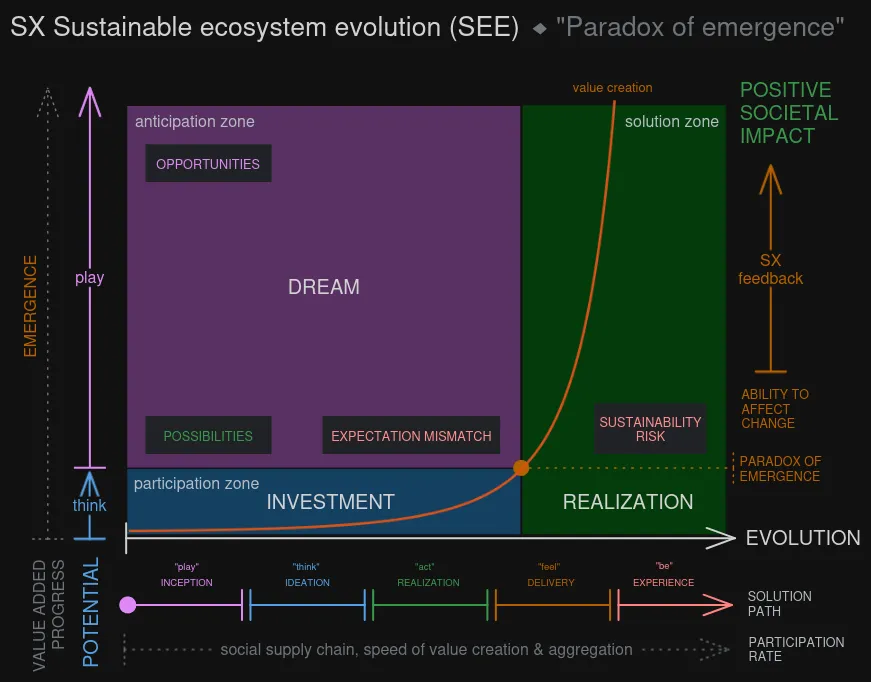
Alt-text to the diagram. Click to expand a detailed explanation.
The diagram shows an exponential ‘value creation’ graph, with on the X-access the progress of evolution along the solution path. Below the axis the various lifecycle stages of the fediverse service delivery lifecycle are listed: Inception, Ideation, Realization, Delivery, Experience. Rate of value creation & aggregation of the social supply line depends on participation rate.
On the Y-axis is the Potential of the solution design, where value-add of investment in the solution depends on how emergent design leads to desired outcomes. It is not easily perceived as it exists mostly still in emergent space.
Diagram has 3 quadrants. On the bottom left the participation zone is where prolonged Investment is asked, while only little value can be demonstrated in the field. The biggest part above the participation / investment zone is the anticipation zone, where we dream and find possibilities and related opportunities that may have great potential. Expectation mismatch is a risk as the emergent value is stil invisble to most people.
The paradox is solved at an inflection point along the evolution axis of the solution, called appropriately ‘the paradox of emergence’ point, when actual value is demonstrated by positive societal impact that grows via SX feedback loops. This is the solution zone, the full right side of the diagram, where value creation can grow exponentially and dreams turn to their realization. Now there are sustainability risks to healthy evolution to monitor well.