
Fediverse of dreams
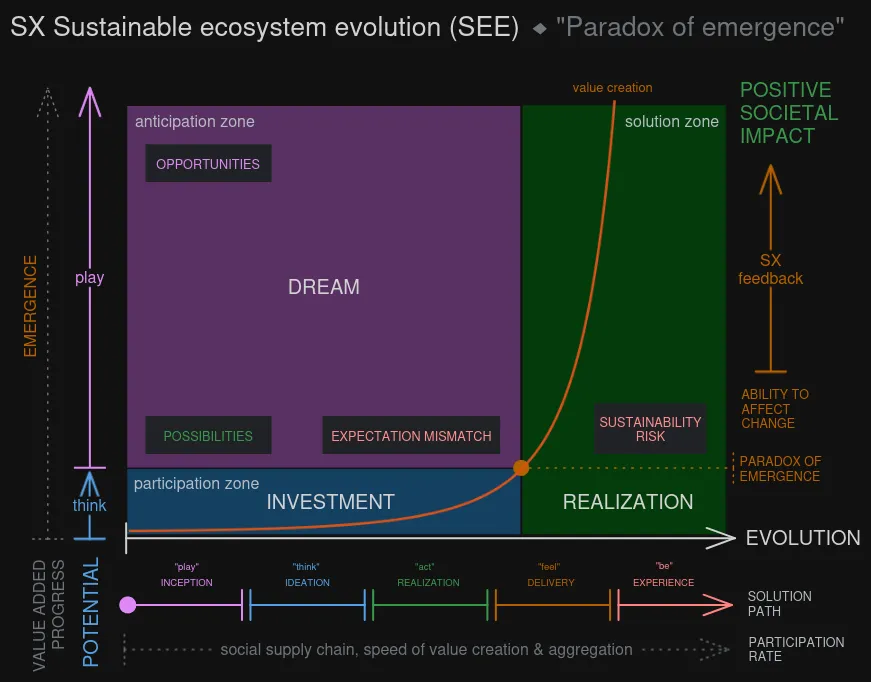

“Invest in your dreams to make them real”. It is but a simple credo, but one that more people might take to heart in their daily work, hobby, and life. Dreams about possibilities that exist, helps perceive and be ready when opportunities arise. Preparedness generally leads to better outcomes of the fruits of our labor. Yields higher benefits, leads to richer rewards. Think now, act better, so we can play more. Get on top of our own game. Basic common knowledge, platitudes really. Yet our modern world, the doomspiral of the daily news, our technological advances that are totally out of whack with what society needs. Hypercapitalism itself, this unfair fitness formula that drives Humanity to ruin and Humankind to the brink. They all disencourage us from having dreams and follow them through. To ensure bright future together we have to “dare to dream” in concert and at scale.
“Follow your dreams” is another platitude. Yet it is an #UrgentPlatitude that serves us well to take its universal wisdom to our heart. Paradox of Emergence tells the tale how our inability to dream, withholds us from realizing our vision. This article reflects on how FOSS and fediverse movements can make sustainable progress and evolve towards a brighter future. All it takes is that we “dare to play”.
Alt-text to the diagram. Click to expand a detailed explanation.
The diagram shows an exponential ‘value creation’ graph, with on the X-access the progress of evolution along the solution path. Below the axis the various lifecycle stages of the fediverse service delivery lifecycle are listed: Inception, Ideation, Realization, Delivery, Experience. Rate of value creation & aggregation of the social supply line depends on participation rate.
On the Y-axis is the Potential of the solution design, where value-add of investment in the solution depends on how emergent design leads to desired outcomes. It is not easily perceived as it exists mostly still in emergent space.
Diagram has 3 quadrants. On the bottom left the participation zone is where prolonged Investment is asked, while only little value can be demonstrated in the field. The biggest part above the participation / investment zone is the anticipation zone, where we dream and find possibilities and related opportunities that may have great potential. Expectation mismatch is a risk as the emergent value is stil invisble to most people.
The paradox is solved at an inflection point along the evolution axis of the solution, called appropriately ‘the paradox of emergence’ point, when actual value is demonstrated by positive societal impact that grows via SX feedback loops. This is the solution zone, the full right side of the diagram, where value creation can grow exponentially and dreams turn to their realization. Now there are sustainability risks to healthy evolution to monitor well.
Contents
Section titled “Contents”Paradox of emergence
Section titled “Paradox of emergence”There exists a paradox to bringing our dreams to realization, which I dubbed The Paradox of Emergence, that makes following dreams much harder to achieve in daily practice. We are all dependent on many other people to support us in our aspirations and to get further in life. To provide help in areas where we are lacking. The paradox manifestates itself in how it prohibits us to convey our dreams well enough to others, so they follow along and help contribute to their fulfilment. It exhibits itself and is visible all across human society.
Emerging the future
Section titled “Emerging the future”What does the future have in store for us? Is it dystopia, or post-hypercapitalist sustainable society? Utopia even? The philosophical answer is simple: We all decide our future together. In practice, of course, the vote is rigged, the powers unbalanced, the game is unfair. And we, the people, always drew the short straw until now, at the cost of Humanity and Freedom on every toss. Greed winning always, at all cost. Society eroding. Or so it seems. Negative news spreads faster, better, and drowns out our positive achievements. We are unable to see the big picture, and how our two cents adds to the sum of its parts. We dream of a better world, and contribute to the best of our ability.
In particular where Grand Dreams are involved that require solving wicked problems the Paradox of Emergence rears its head. Our efforts to tackle global Climate Change is the best-known example of a truly wicked problem to solve. A warming climate, already destructor of many humble dreams, requires all of our collective power to solve.
The paradox works at all scales and also inhibits countless of the small dreams we have from coming true, even when we try hard to realize them. The personal normal dreams we commonly share, of simple life and happiness. Why is that? It sometimes feels as if the world is actively holding us back from realizing our dreams, even where they are but humble.

“Draw the short straw” by Marcus Connor of BrainlessTales.
With regards to Free software development I raised some highly uncomfortable questions to reflect upon, about the role of FOSS versus the rise and dominance of Big Tech, as well as the existence and capabilities of LLM’s in modern society. Ethical discussions that simply do not take place in our field, in any meaningful way. Jan Riemer pointed me to earlier notes on latent fuctions and dysfunctions, through which I found useful work by Robert K. Merton to look deeper into..
“For me, it is Merton’s stress on the necessity of examining social phenomena for their unintended consequences, for the “unadvertised” effects they produce, that is most striking. Those “latent” yet incredibly potent social forces account for a great deal of our social problems, yet the answers proposed for those problems all too frequently continue to ignore them, or exacerbate them further in seeking to avoid acknowledging them.“
– “The unanticipated consequences of human action”, A synoposis of the Structure-Functional Theories of Robert K. Merton.
We are all doing good, right? Individually, that is. For some time I am asking fedizens whether of not we are building Skynet. And we simply don’t know, as we don’t ponder that question. What emerges from our collective efforts is a good question to reflect more deeply upon, if only to assure we are not just “moving slowly and breaking things” unwittingly. Not much different than the techbro’s in Silicon Valley, minus the commercial business incentive.
Cauldron of dreams
Section titled “Cauldron of dreams”The fediverse social web is a delightful online space that brings together countless people who dare to dream. There is great potential and power in that, yet it remains dormant for the most part until now. Millions of fedizens, often brought together by need, frustration, and worry about the world. Many activists and advocates among them, and countless creators who want to contribute to a better future. People who raise awareness about the dangers of Big Tech and its overly dominant role in global society.
On the fediverse we share dreams about offering alternatives to the many exploitative practices of corporate social media enterprises. We want to rescue people from immoral surveillance capitalists who keep billions captured and captivated, eyeballs glued to their mass advertisement platforms. We dream and imagine post-capitalist societies, and we act to increase the potential of their eventual realization.
Fediverse is an online medium that can unite us on common causes and rally people into concertive action. It provides places to gather and express ourselves, to get organized and have a great time with peers while we are doing so. Fediverse can offer a rich, safe, and vibrant environment and culture fostered together with others. An uplifting place that can keep us motivated and energized to emerge a better future together. To row against the tide of negativity, the doomspiral that has society in its grip. After all, we know that the solution to our big problems is but simple: if we all do our fair share, gave our two cents..
Where Big Tech seeks to alienate us from each other with their AI Moonshots, fediverse holds the key for human Earthrise.
So far, so good. In my blog post relating the need for Shared responsible ownership I argue that shared concertive action is a requirement for a healthy fediverse that is and remains commons based. In other words created by and under control of the people, for the benefit of the people.
Dreams and vision
Section titled “Dreams and vision”So the fediverse evolves and grows organically. But where does it grow to? To repeat Ben Werdmuller’s question in his article Growing the open social web: “why do we want to grow the open social web, and for whom?”. I would expand the question by reformulating the last words to read with whom do we grow the open social web? How can fediverse be inclusive to all these delightful people from all walks of life, who have their own dreams and are motivated to bring their own unique skills to help realize them?
The current fediverse is not good at taking people’s dreams further than just talking about them online. In my article on Grassroots fediverse evolution I outlined a number of wicked challenges to the evolution of the fediverse-we-have versus the Future of Social networking. While a handful of fedi app developers are enabled to dream and build the features they want for “their users”, most people don’t have much say on where the app-centric fediverse is headed in terms of supporting their day to day social activities.
In terms of realizing ideas, the fediverse is like any chaotic grassroots environment, where the social dynamics are such that if two people have 95% overlap in their idea, the most likely outcome is that they’ll create wholly independent initiatives, and start their own FOSS adventure in this unsustainable burnout field of IT. Fragmentation, going it alone, is the norm. And in times where realization of Grand Dreams is called for, fragmentation is another “We divide ourselves to be conquered” tendency that ails a typical chaotic grassroots commons. The other one I regularly observe is the tendency of progressive people to engage in fights and breakups on the slightest difference of opinion, well before even bringing the fight to the enemy, and instead doing their work for them.
Most important about shared vision is to talk about it, to share dreams, exchange ideas, and imagine the future together.
Shared vision entails having a certain collective outlook, a notion for where the fediverse is headed, and what we want it to be. So that we can monitor progress against common goals, and make timely course corrections. Without it, the fediverse is just a wall plug for any arbitrary tech. Directionless and purposeless. Unless that is the vision: “Fediverse is a universal wall plug for interoperable social media apps”. There’s no shame then. Many technology standards envision purely the technical merits of their adoption. Yet I do not think most fedizens will find that an appetizing vision. Deeper reasons brought all of us together, not just decentralized apps.
The expert problem
Section titled “The expert problem”As I gained community organization experience over the years, I observed how the concept of “having a community” is often readily accepted, while what that actually entails in practice still remains entirely unclear. The name “community” is brandished, but not what it means to be part of it, and what is expected of members to assure community health. Expectation mismatch becomes a major risk factor, and often leads to the demise of a community. Especially where both the scope and audience are large, fostering healthy communities becomes extremely hard, and community organization highly challenging. In many cases the term “community” does not cover the load, and should be avoided altogether, or have a clear scoped definition within a larger context.
Where “Community” is vaguely defined, unmatched expectations thrive that hamper healthy community evolution.
When I started facilitating the now dormant Humane Tech Community I initially organized the forum on a scope and audience that was basically “everything and everyone”. This aligned with the rallying cry of “Triggering a world-wide cultural awakening” adopted from the Center for Humane Technology, by Tristan Harris et al. The forum attracted both worried parents as well as academic researchers in social and technical sciences. While quite diverse, these different community stakeholders weren’t interested in each other’s content. The academics were too technical for the parents, and vice versa the parent’s talk was seen as distractions to the researchers. After a while I noticed that new community members would only join to detract people from Humane Tech Community to their own initiatives instead.
Modern society encourages us to specialize, to become experts in a certain field. The tendency to attract people away from broader forms of organization into more specialized groups is a natural social dynamic resulting from the overly broad scope and audience definition. People crave order, manageable scope and overview, the feeling of being in control. And organize accordingly, usually in top-down fashion. Bubbles of specialization are formed where people speak their own language and technical jargon.
The lack of shared vision hampers the ActivityPub fediverse from becoming more diverse and inclusive, and attractive.
Saying “ActivityPub developer community” is prime example of entering the danger zone of unmatched expectations. Only in the most generic and handwaving sense is there real community in the ActivityPub ecosystem as a whole. Instead at smaller scales there are many people, groups, and initiatives that interact opportunistically and based on mostly self-interested motives. That is not community, but raw chaotic commons, unorganized and inefficient. I am talking from experience, from years of facilitating SocialHub and weaving in public, advocating ActivityPub technology.
The ActivityPub developer community, as considered in this broad undefined meaning, faces big DEI challenges. It is impossible to perceive people’s needs and adequately address them, if we don’t take them into account. The way in which fediverse evolved until now, as a pure technosphere, has made it not inclusive at all. Today this community is most friendly to a technical, app-centric crowd that follows FOSS approach to app development, is pragmatic, no-nonsense, code-oriented, and serving mostly narrow social networking use cases. The community is inclusive to the “Tactical developer” role, and not so much to any other stakeholder roles that are essential for healthy ecosystem formation.
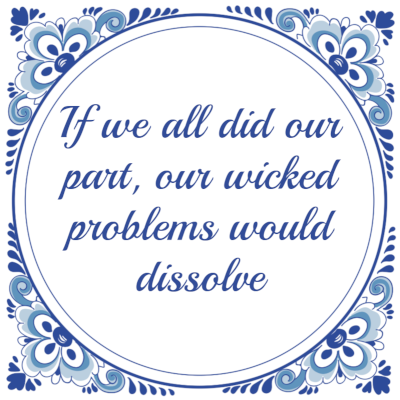
“Urgent platitude” by Humankind, the social coders.
Simple solutions still exist. If we all did our fair share, we can solve the big problems of our time. The wisdom tile above, an urgent platitude, holds but a simple thought experiment. If only in practice it were that easy: just aggregate everyone’s two cents of value. Why is our commons so inherently unsustainable? Why is it near impossible to earn a decent salary in FOSS, while FOSS software contributes almost 9 trillion dollars to the global economy?
“Burnout is not just a problem for [F]OSS developers, it is a problem for all of us. It is also a problem that can be most effectively addressed by working collaboratively to achieve system-wide change.”
– “A Report on Burnout in Open Source Software Communities” by Miranda Heath.
Why is dabbling in FOSS circles on anything more than hobby projects such a brutal burn-out zone, and why do we seem unable to bring any improvement to that? Simple solutions still exist. If there is so much value being created then it must be easy to retain just a small fraction of that and be able to pay decent salaries to all the fine free software creators in our commons, right? Apparently not.
Hedonic peer production
Section titled “Hedonic peer production”“Invest in your dreams to make them real” is the basic impetus behind the SEE model for Sustainable ecosystem evolution. Dare to dream, and then dare to play. Those are the hedonic drivers to trigger the emergent forces that are involved with Hedonic peer production at scale. To enable furtile cocreation in chaotic grassroots environments, we must first “dare to dream”, to be able to perceive possibilities, opportunities that exist, benefits and rewards to be gained. That is the first step, the easiest one, which subsequently allows us to “dare to play” where it yields most value for all participants.
Timeless progress
Section titled “Timeless progress”Especially when there is much urgency to solve big problems, the Paradox of Emergence comes to bite. When we are rushed, we are no longer able to see how our humble two cents of ‘world improvement’ adds up to the whole. Unable to see how our small contributions create more than the sum of their constituent parts, and how they relate to making sustainable progress. As it happens nowadays everyone is rushed, info overloaded, deeply absorbed in their rat race. Too rushed to know what we are doing, and whether the result of our work has the desired positive impact in the grand scheme of things. Short-termism prevails, forcing all of us to become tactical tornadoes in a definition similar to John Ousterhout’s book “A Philosophy of Software Design”.
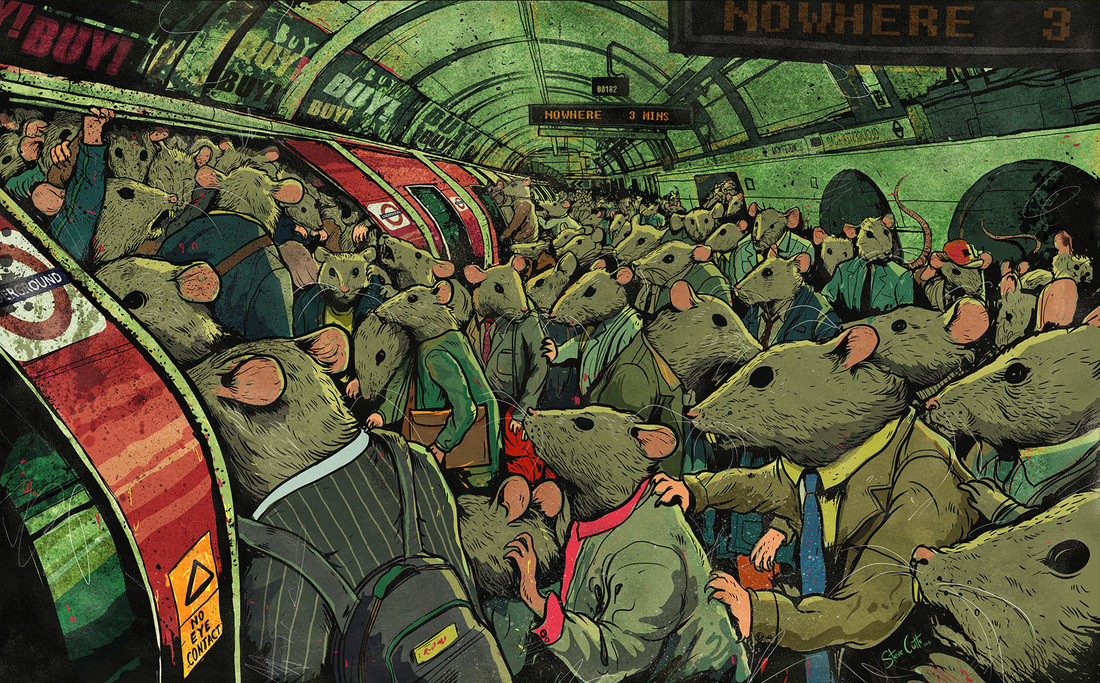
“Going nowhere” by Steve Cutts.
For the elaboration of Social experience design I always took ‘hypercapitalism’, capitalism-run-amok, as a root cause when thinking about ways of uniting grassroots commons into collaborative cocreation networks. And I still do. However, based on my experience over the years doing community work and observing the social dynamics, I have added a deeper root cause to be taken into account for SX. One that exists at a level lower on the Pyramid of Perspective, where inter-personal relationships are involved..
Attention is the new oil of hypercapitalism, and distraction, our inability to listen to other people, is its lubricant.
The new oil isn’t data, as is often mentioned. Perhaps when just considering the technosphere, it is. The real fuel for the mad hypercapitalism engine is to make everyone rushed, info bombarded and overloaded, unable to deal with urgent matters that require coordination between many people to solve. The general inability for people to attentively listen to others, to reflect and provide thoughtful feedback, is a root cause that ensures hypercapitalism keeps going strong and we can’t solve our wickedest problems. Our attention is distracted, diverted to ‘bread and games’, gets lost in a cacophony of misdirection and misinformation, and we become unable to perceive how our two cents of good intentions adds up to the whole. We are drowning in data, yet starving for information. It hampers our ability to realize solutions for wicked problems.
Chaordic commons forms a movement that can only progress, aggregating value from proactive participants all the time.
For a commons to become focused and directional, able to make durable progress and to sustain healthy evolution and natural growth, it must become aware of the needs of its individual participants and how it is able to address them. People must be able to pursue their own dreams, in alignment with a shared vision. Dreams are personal, and shared vision is emergent. The core principles of Social experience design, respectively Mindfulness, Sustainability, and Playfulness serve the purpose of making proactive commons participation beneficial and rewarding, keeping participants intrinsically motivated to become deeply involved.
Cross pollination
Section titled “Cross pollination”In the Big Industry analogy I made on social coding forum, the observation is that FOSS projects can only operate at smallest scale, whereas Big Industry can tackle any scale and complexity and be highly profitable. You might say that it is money that makes all the difference. Where at the factory supply lines employers keep their employees motivated to show up at work by the salary they pay, and in turn can dictate them to be ready at the right moment in time, to do the right thing. And because FOSS lacks the money, we are unable to do the same. But this is way too easy, and would lead to an unsolvable chicken and egg for sustainable FOSS. The money is merely a handy tool for Value exchange.
The article “The Firmbyte Gap: Why the Most Valuable Connections Never Happen” mentions the work of physicist and economist César Hidalgo, who studies how economies grow and evolve through the embodiment of increasingly large amounts of information, that enable us to build very large and complex products. Hidalgo calls the emergent process by which this happens “crystallized imagination”, that involves collaboration between many people who individually can only oversee a “personbyte”. Successful economies distinguish themselves by their ability to form diverse networks of individuals and how good they are at sharing the right information at the right time.
“tl;dr Complex products require more knowledge than any single person can hold — Hidalgo calls this a “firmbyte.” The most valuable firmbytes span unrelated domains, but people self-sort into clusters where everyone knows the same things. The result: a massive, invisible gap where breakthroughs should be happening but aren’t.”
“The Firmbyte Gap” by Björn Roberg.
Crystallized imagination via emergence. That is very applicable to what it entails “To reimagine social” and envision a peopleverse. But as Björn explains in the article, it is very hard to bridge “the firmbyte gap” and bring people together in the right knowledge networks. For our fediverse to become The future of Social networking the scope and audience is nearly “everyone and everything”.
According to Prof. Andrew Hargadon the solution is to be found in better “knowledge brokering”, which for the fediverse then needs to happen at full ecosystem scale. Hargadon says that for solving the knowledge brokering problem three capabilities are required. These capabilities are not well established in the fediverse ecosystem, and should be focus areas for healthy grassroots evolution.
The fediverse is an ideal environment where cross-pollination can take place. And to a certain extent I am sure it does. We get inspired by what we read in our timelines from fedizens across the social graph. Yet on the other hand it is clear to see we can only do the bare minimum with the tools we have today. For instance the people in the ActivityPub developer ecosystem have shifted their primary means of communication to occur by microblogging alone. It is a low-barrier form of communication, but incredibly, astoundingly inefficient, and ephemeral. It does not retain or spread knowledge. Information exchange takes place between people who are mentioned, and those who are lucky enough to catch it in their timeline. A regular post is actual for a single day or so, while a post that triggered good discussion might be actual for a whole week. After that all substantial discussion is lost in timeline history.
The fediverse is one big low-hanging fruit to improve the atrociously inefficient communication that it currently supports.
Fediverse today still is only “twitter but decentralized”. There have been efforts to support a “threadiverse” and the SocialCG has a Forums and Threaded Discussions Task Force, which brought better support for long-form posts to the timeline, and a number of great forum softwares like Discourse and NodeBB to offer ActivityPub integration. Using these products with their richer forum-related feature sets can help to significantly improve effectiveness of communication. But only to the “user”. The rest of the fediverse now gets a timeline where short-form (sticky note) posts are intermingled with long-form (article) posts. And this is just adding ‘support’ for one type of application.
In my fediverse timeline I recently overhead ActivityPub developer discussion, stating that the “fediverse consists of a feed and a notification stream”. This is only true if you throw the power and promise of ActivityPub out of the window, and accept that fediverse is mostly just microblogging. Instead what ActivityPub gives is “a social graph of addressible actors that exchange activities with an object payload”, which is incredibly powerful and versatile. And also familiar. We are talking about message-driven architecture, for which a huge body of existing work and best-practices exists. The narrow perception of what fediverse offers comes forth from the ‘tactical developer’ mindset that looks what currently happens on the wire, and how to hook into that with something extra to be glued onto that somehow.
The task of the Social experience designer who is ‘reimagining social’ is to step away from the technosphere and consider the desired modes of communication between people first. Analyse the needs for social interaction and the purpose of information exchanges, and only then translate to technical constructs on the wire.
Joyful creation
Section titled “Joyful creation”So the fediverse is full of people who dare to dream, are very creative, and have a great diversity of skills to bring to collaborative arrangements. Beyond a microblog communication channel fit for chattering, the next step to the Future of Social networking is a fediverse that natively supports cocreation.
Only when we “dare to play” well together, can we be united on a common cause, and reap the rewards and fruits of our collective efforts: offering solutions to the wicked problems of our time. For that we must learn how to collectively make sustainable progress towards common goals, and bundle the emergent forces of our coordinated efforts.
[..] modern technology has deprived man of the kind of work that the enjoys most, creative, useful work with hands and brains, and given him plenty of work of a fragmented kind, most of which he does not enjoy at all. It has multiplied the number of people who are exceedingly busy doing kinds of work which, if it is productive at all, is so only in an indirect or “roundabout” way, and much of which would not be necessary at all if technology were rather less modern.
– Excerpt from “Small is Beautiful” by E.F. Schumacher, 1973.
Social experience design has the concept of SX formula’s, which entail the adoption of a shared vision and the Intent to realize them within the grassroots movement. Joyful creation is the name of a formula that envisions a social web that seamlessly supports collaboration and cocreation between people. Joyful creation was inspired by and is a generalization of Dan North’s vision of Joyful coding, to encompass any form of cocreation.
In a 2020 paper “Characterization of Expert Problem-Solving” the authors Argenta Price et al make the interesting finding that a set of only twenty nine but inter-linked decisions are common to the solution process in any field or expert area, and that they involve very domain-specific knowledge for the decision-making. This empirical universal problem-solving framework can serve as a good guide for the elaboration of SX methodology and to mitigate The expert problem. SX has the concept of Social activity tracks that may support this framework to provide clear insights on decision-making process, the stakeholders and skills involved, and needs that must be addressed..
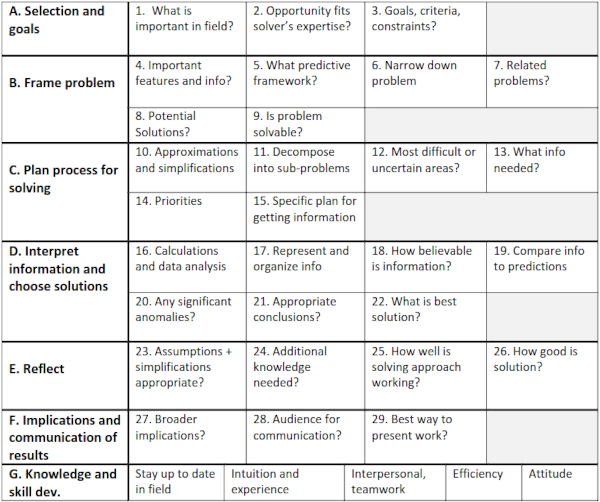
For the evolution of Social experience design, and to get beyond long-form blog posts like this one - which are likely to fuzzy and fluffy to be appreciated by a die-hard tactical developer - the business domain of Social experience design must be modeled so that it can be natively supported on the fediverse.
Sustainable ecosystem evolution
Section titled “Sustainable ecosystem evolution”Social experience design is an universal emergent evolutionary solution development methodology. That is a mouthful. In this article and the other blog posts on the social coding website I introduce many new concepts and terminology. These aren’t all that important to the average cocreator, and they do not have to learn and master SX at all. Yet they must be formally defined to be able to offer automation support for solution development processes across the social supply chain. They form the design language of SX, which will be elaborated by ‘working in commons’ rather than in public, because only targeted audiences are interested and required to know them.
The entirety of Social experience design constitutes a Vision, that is in service to a Dream: to be able to cocreate a peopleverse.
The breadth and width, the holistic scope of SX and the mindset shift that is required to grasp some of the major concepts of this solution development methodology causes the Paradox of Emergence to be a tough challenge to overcome with SX just in its early beginnings. Looking at the SEE model at the top of this article, most of what I talk about exists in the “anticipation zone”, where only dreams, possibilities, opportunities, and potential exist.
Fostering emergence
Section titled “Fostering emergence”How to foster emergence, in a time where rushed people can only dig “Show me the money” quick elevator pitches? How can we organize and practice SX related activities at scale over prolonged periods of time with investment by many people? To create Golden Dragons that are ready to emerge as innovative solutions to wicked problems. The paradox is that until our Dragon emerges to breathe golden fire of positive societal impact, it exists for the most part as pure Potential only. This makes asking for investment a tough sell.
“Urgent platitude” by Humankind, the social coders.
The nature of emergent design is such that most non-designer stakeholders, who are not deeply engrossed in the subject matter and are unaware on how emergent forces interact, find it very hard to oversee how the information they read relates to desired outcome: a solution that satisfies their needs. Even the designers themself can easily lose sight of the Dragon on a bad day when they dabble with immediate pragmatic issues, and then find it hard to convey the solution they are working on, to others. You can make an analogy with the game of chess. Suppose you are the first inventor of the game. How do you explain to people how wonderful the games is, much more than just shuffling wooden pieces over the board based on a simple ruleset? Explain that one day libraries full of chess theory will exist and Magnus Carlson level chess geniuses take the game to unprecedented heights?
Perseverance is part of fostering emergence, especially at those times where the pent up potential value that is the result of prolonged investment in a solution is not readily clear or temporary lost because of pragmatic distractions. At such times only the most recent two cents of contributions are apparent, and that can be very discouraging. Raising the question of “What have I achieved thus far”. However, the value does aggregate, if it is handled well. The collaboration tools we use, increasingly having native social web support, can be of great help to keep direction and focus. Modeling the communication channels of the chaordic organization to support emergence is important. This needs not be complicated at all, just a deliberate process. An example is the current social coding forum, that uses existing Discourse forum software as a note-taking tool and archive of aggregated value.
“Ask not what you can do for the commons, but what the commons can do for you.”
— First principle of Hedonic peer production.
In addition to tool support another mindset shift can significantly alter our perception of the commons we are part of, and how we participate and collaborate with others in creative processes in ways that align best with our own self-interests, and thus with highest intrinsic motivation to contribute to each other’s dreams. However, this is a whole different topic that is for another blog post.
Value exchange
Section titled “Value exchange”The purpose of Social experience design when practiced at scale is to create furtile, vibrant, and inclusive commons where we can be creative and in the pursuit of our dreams. With sustainable income if that is part of our Needs. The evolution of the fediverse into a peopleverse is able to provide that on the basis of shared responsible ownership. SX aims to foster a commons based value economy that is supported by the social web. It takes social networking beyond serving an attention economy, to support an Intention economy.
This intention economy goes a bit deeper than the sparse definition on Wikipedia. In the cross-pollination section above I mentioned that value exchange is key to Big Industry’s ability to manage hyper-complex global supply lines. What is value, if we look at a commons? What is valuable to exchange? The practice of value perception is key to answering these questions. Social experience design takes the intrinsic values of Humanity and Freedom as the broad basis to evaluate value against. And specifically we are talking about value in use versus value in exchange. The latter is how the business world commonly perceives value: as the output of a firm that leads to a price for the exchange. Value in use is a much richer concept that considers value creation and exchange in all the steps and activities of a social supply chain, which is transferred by means of service delivery and exchange.
This perspective of value and how it is exchanged by service delivery is particularly well-suited to find application on the social web. By modeling Hedonic peer production on the ActivityPub fediverse based on the core principles of SX and the intrinsic value, a kind of Happiness economics can be fostered in a commons, that yields a positive and uplifting can-do environment where people work together at scale to cocreate SX solutions. An environment that hooks into each person’s intrinsic motivation to proactively participate with others.
Valueflows support distributed economic networks to coordinate the creation, distribution, and exchange of economic resources.
Already there exist some very interesting initiatives that move in the direction of offering such native support for value (in use) exchange. The Valueflows initiative by Lynn Foster and Bob Haugen offers a flow-oriented approach and ontology to model the value exchanges in commons based solidarity economic networks. Their initial exploration to extend ActivityPub with Valueflows led to the drafting of FEP-0837: Federated Marketplace by Silverpill, developer of Mitra and maintainer of the FEP process. FEP-0837 already has implementations by Mitra, flowmarkt and Fedify. In addition the Bonfire Networks initiative offers a Valueflows extension and Communecter is planning Valueflows support.
Prosocial commons
Section titled “Prosocial commons”Social experience design particularly aims to induce prosocial behavior - social behavior that benefits other people or society as a whole - between commons participants via mutualism and reciprocity, and by focusing on Rewards rather than punishment. A well-designed SX solution will yield most benefit to prosocial actors, while by bad actors by their behavior place themself out of reach of the rewards. The bad actor punishes themself as it were, by their behavior, and is therefore encouraged to either improve or miss out. This idea is key to innercircles life philosophy: To demonstrate the power of Humanity and Freedom. To quote an article of Dr. Leah Howard, prosocial behavior is how shared values contribute via cross-pollination to shared vision and in alignment to individual dreams of commons participants.
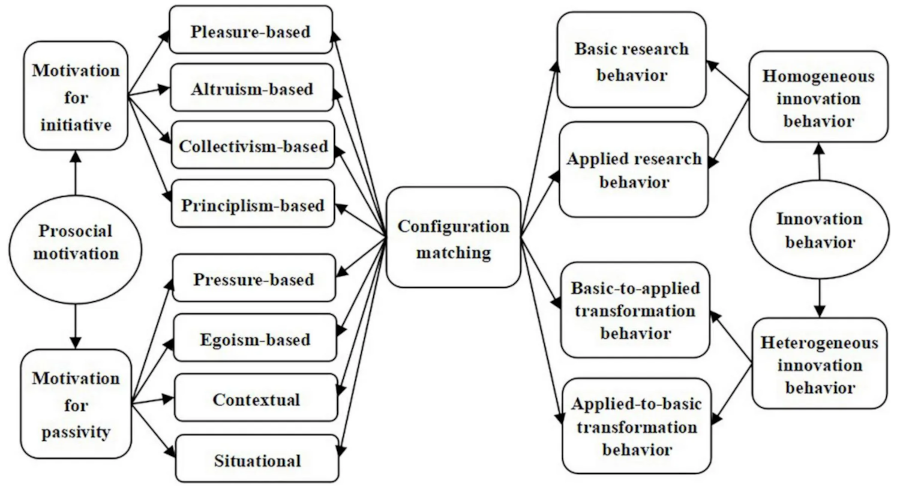
There is a large body of work to take inspiration from for the modeling of prosocial networking, such as the framework above on how prosocial motivations contribute to innovation behavior in a 2022 paper by Yuting Lu et al. Or, more directly related to UX, there’s a great pattern library maintained by the Prosocial Design Network, that currently contains over 50 prosocial patterns.
Social coding commons was initiated in 2025 by Arnold Schrijver and came forth from “Social coding movement” that preceded it. Years of experience in facilitating communities and doing technology evangelism via “weaving in public” in difficult and broad-scoped grassroots environments preceded this inception, whereby Arnold deliberatedly acquired new skills and studied the social dynamics as an insider active in the field. In 2018 he founded Humane Tech Community (which is now dormant) and from 2019 spent five years as community facilitator of SocialHub and the FEP Process, the developer community for the W3C ActivityPub social web protocol and the fediverse. Dealing with all the frustrations of ‘trying to herd cats’ and ‘commons janitoring’, doing the boring chores for others, he learned that the major challenges of the fediverse to overcome are mostly social in nature. Social coding commons constitutes an ongoing experiment to finally address them in a collective effort, with many people working in unison together.
Arnold Schrijver now acts in a custodianship role, since Social coding commons is leaderless. He is available for inquiries on the fediverse at @smallcircles@social.coop, on Social coding forum as @aschrijver, and as @circlebuilder:matrix.org on Matrix chat.