
Shared responsible social web ownership
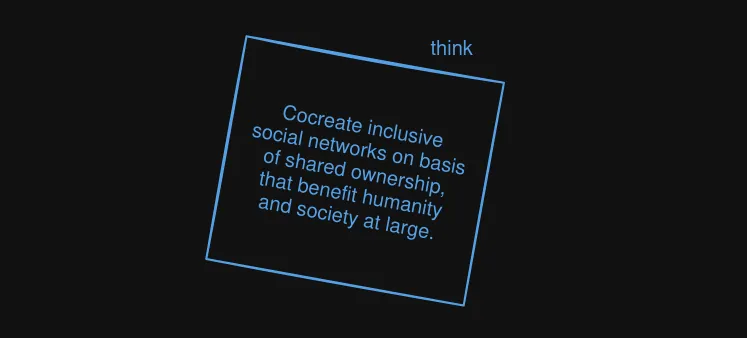

This post is written in response to discussions in the Social experience design chatroom that ponder the question whether we must develop fediverse regardless of whether bad actors also benefit from our work.
Not doing something that would empower humanity because it would also “benefit authoritarians” is where the issue is. I believe the saying is “cutting off the nose to spite the face”.
The general uses benefit everyone, in the same way universal healthcare or access to clean water also benefits everyone. yes, even the people who don’t need it.
What are we cocreating together?
Section titled “What are we cocreating together?”That our work “empowers humanity” is an assumption that the net result of its impact on society is positive, and I don’t know if this holds true in how we currently evolve the fediverse. Our devices are owned by Big Tech. If we build superpowerful decentralized software that falls in the hands of Big Tech we may be worse off. What we don’t have today in most of the world are Big Tech “super apps” that are required to be used by everyone to even participate in society. Like you have AliPay and WeChat in China, where cash payments have all but disappeared. We trend in the direction of composable applications that form super apps. If we build tech innovations we cannot own, we only help those who would dominate us. Going forward with best intentions, we nonetheless prepare the way to our own domination and further submission to Big Tech and its owner class. Technology innovation by itself does not mean progress for humanity.
It is a tough dilemma, and almost a paradox. This upside, the thing that “empowers humanity” is certainly there. At the same time we develop it under the conditions of hypercapitalism where we are almost certainly going to lose control over it, with our current approach. Must we build the atom bomb, before others do it? Or even just carbon-neutral nuclear power technologies? Not a really good analogy, but it highlights a similar difficulty in getting desirable outcomes.
The quest to “empower humanity” is valiant. But what exactly does this entail? The fediverse is decidedly NOT first and foremost a project aimed to empower humanity. That is only what a handful of pioneers want the fediverse to achieve. Meanwhile the person next to you is just building a technology platform that’ll earn them big bucks, and the Big Tech giants are keeping an eye on things to not become a threat to them and what they can usefully adopt. A corporate takeover looms, triggered by growing commercial interest. Fediverse very much evolves mostly in the technosphere. It is all tech talk all over the place, and much less “empower humanity” strategic planning and well-coordinated action. If empowering humanity was the overarching goal then much more attention would need to be placed on “where do we end up with all of this?”, and talk about the vision of the future social web from the perspective of the sociosphere. There’s hardly any of that today.
Ben Werdmuller just wrote Growing the open social web and starts off with the important question “why do we want to grow the open social web, and for whom?” and then continues to saying that we need shared ownership. The article says all the right things, and I can’t agree more with it, but at the same time it only hints at the desired outcome but does not yet outline the solution, and the path towards it. How do we guarantee we build things having what we call “ownership”, where this new tech isn’t slapped from our hands by the next wave of Big Tech products?
Responsible healthy evolution
Section titled “Responsible healthy evolution”Inclusion, equity, and shared ownership. That might be on the sticky note of the SX solution design at the start. Yes, open technologies. Yes, protocol standards. To a degree. No, proliferation to Big Tech. Note that the ownership part becomes more important than the “open” part. The ownership requirements should drive the openness of the technology. You can compare with the Russian war on Ukraine, where you wouldn’t want open trenches laid out according to all-accessible protocols. That basically guarantees you lose the war.
On the development side Social experience design via “working in commons” provides a means for inclusive cocreation of a healthy technology base that is able to evolve and driven by stakeholder needs. As for the solutions-side, the social experiences being delivered, care should be taken that these solutions do not fit the needs of Big Tech, who are not a stakeholder in our solution designs. So when does Big Tech become interested in what we do? Roughly in two places. When they can earn money and power, and when they risk losing it. Our success inevitably means they’ll lose, so it is clear they will join a fight full-on when our solutions become influential enough.
Then for starters up to the point where that happens we can discourage their technology adoption, their entry in the field, while we gain strength, mature the technology base, and position ourselves for the fight to come. For years I have been frustrated about the lack of progress in fediverse open technologies and standards, complaining about the development approach that ever increases protocol decay and tech debt, making interop harder and not easier. But if anything it has bought us time, so we can gather more numbers and become better organized and on the basis of grassroots dynamics that play to our strengths. Healthy culture needs to be nurtured and fostered, and this is by no means easy. The latest fediverse vs. bluesky megathread I bumped into yesterday shows this all too well.
The amount of social protocols that are used and how they interact, are all technical concerns, and tech should not have the prevailing focus if the goal is to “empower humanity”. Tech only serves. Where do we want to be in the future, and what needs must we address? Those are social, if not societal questions. We must solve wicked problems.
Ownership requires shared concerted action
Section titled “Ownership requires shared concerted action”From a pure technological perspective we can imagine technologies that aren’t attractive and useful to Big Tech and other corporate exploitative actors. Build systems that aren’t profitable enough, and do not align with their hyperscale business models which are based on surveillance capitalism, unfair market domination, and stubborn network effects. Find the weaknesses of Big Tech and pounce on them. Work around hypercapitalist models to avoid Conway’s Law from creeping in our solution design. We can apply personal social networking to tailor solutions exactly to our day-to-day needs. We all carry powerful computers in our pockets that are certainly able to support our online and offline social networking activities. We need not design for scale. Design for ease of use and accessibility where small individuals can eek out a living. And where there isn’t the profitability that makes a Big Tech giant take an interest and jump in the fray.
Our biggest strength however, is a dormant one. It is the power of numbers of the grassroots movement when it is ignited and sparks into concerted action. This strength might be our biggest weakness at the same time, as we seem unable to tap into this power. Unable to ignite the commons. While we individually all do the right things, there is a lack of shared direction, common goals, and coordination. And where we try to organize at scale, we do let Conway’s Law apply by applying “herding of cats” top-down governance models that are not fit for large grassroots movements. These models only work in smaller organizational settings, with clear audience and well-bounded scopes.
How do we ignite the commons?
Section titled “How do we ignite the commons?”It is this wicked problem and highly fascinating challenge that is at the heart of Social coding commons and Social experience design. SX focuses on the healthy evolution of entire technology ecosystems in grassroots environments on the basis of well-stated needs and objectives. SX recognizes that the concerted action and coordination that is needed, cannot be enforced. They are emergent forces that can only be facilitated, encouraged, and thereby reinforced. The SX research field of Hedonic peer production is the mechanism by which this happens. It is based on the notion of self-interest and maximising the incentives for people to participate and collaborate in order to better address personal needs.
Elaborating Social experience design is an adventure quest. There are ups and downs, frustrations and controversies, but our Social web is maturing, gaining resiliency all the time, enriching its culture. This takes time. Slow growth is a boon, it is only natural, and evolution is an organic process. Igniting our commons is the point where our Social web allows people to truly blossom and society to bloom.
Our revolution is Evolution! All it takes is for everyone who gives a dime, to contribute their 2 cents. And then reap the rewards.
Discuss this article on our Social coding commons forum, in the Social experience design chatroom, or react to my post on the fediverse.
For some inspiring videos on the future of the Social web I recommend watching Darius Kazemi’s Q&A Keynote talk “Let’s play and win our own game” given at the 2019 ActivityPub Conference in Prague. And very recently the urgent talk by Michiel Leenaars, the director of NLnet, at FOSDEM 2026 titled “FOSS in times of war, scarcity and (adversarial) AI” which addresses the many challenges we face today, and new threats to FOSS (and the social web) that is posed by the unprecedented and highly disruptive rise of AI technologies. NLnet is a major supporter of healthy fediverse evolution, and provided EU NGI funding and services to well over 86 commons based R&D initiatives.